
For nearly a century, digital computing has relied on a single fundamental concept: the bit. Everything from standard web browsers to advanced artificial intelligence operates on strings of zeros and ones.
However, modern technology is reaching the physical limits of traditional silicon chips. To solve humanity’s most complex computational challenges, scientists and engineers are shifting away from classical architecture and moving toward quantum computing.
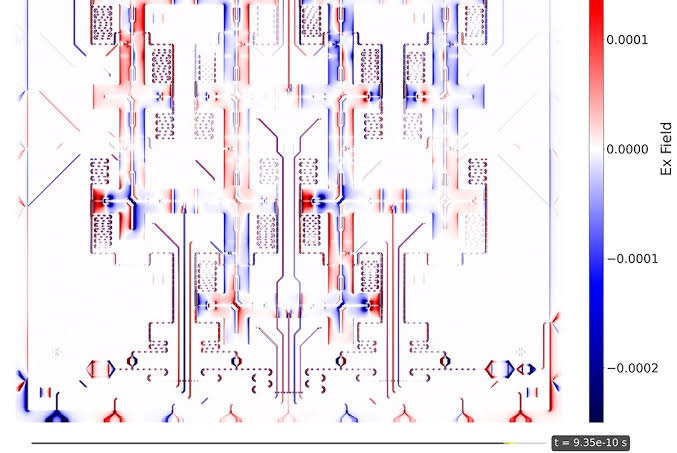
Quantum processor layout running complex qubit state simulations. Source: Berkeley Lab News Center – Lawrence Berkeley National Laboratory
What Makes Quantum Computing Different?
Classical computers process information sequentially. A bit is strictly a 0 or a 1. Quantum computers, by contrast, harness principles from quantum physics to process vast amounts of complex data simultaneously.
-
Superposition: Quantum bits (qubits) can exist as a
0, a1, or any fractional ratio of both states at the same time. This allows a quantum processor to evaluate millions of potential outcomes at once. -
Entanglement: Qubits can become fundamentally linked regardless of distance. Changing the state of one qubit instantaneously influences its entangled partner, enabling exponentially faster parallel processing.
-
Quantum Tunneling: Particles can pass through physical energy barriers, allowing algorithms to discover optimal mathematical solutions far faster than classical brute-force calculations.
Classical vs. Quantum Computing
| Feature | Classical Computing | Quantum Computing |
| Basic Data Unit | Binary Bit (0 or 1) |
Qubit (0, 1, or Superposition) |
| Operation Type | Sequential / Deterministic | Parallel / Probabilistic |
| Operating Temp | Room temperature | Near Absolute Zero ($-273^\circ\text{C}$) |
| Primary Strength | Daily software, web, database queries | Complex simulation, cryptography, optimization |
Real-World Applications Transforming Industries
Quantum computing is not designed to replace personal smartphones or laptops. Instead, it serves as a high-powered engine for supercomputing challenges across global industries:
-
Next-Generation Battery Chemistry: Simulating molecular interactions at an atomic level allows researchers to design EV batteries with higher energy density without years of trial-and-error laboratory experiments.
-
Pharmaceutical Discovery: Simulating complex protein folding allows drug developers to model new life-saving treatments in hours rather than decades.
-
Logistics & Supply Chain Optimization: Calculating optimal global freight routes, fleet movements, and energy grid distributions in real time reduces waste and carbon emissions.
The Road Ahead: Fault Tolerance and Decoherence
Despite incredible progress, quantum hardware faces a critical hurdle known as quantum decoherence. Qubits are hyper-sensitive to external noise, thermal fluctuations, and electromagnetic signals, which introduce errors into computations.
Engineers are focused on building fault-tolerant quantum systems with built-in error correction. As stability improves and quantum processors scale past thousands of physical qubits, quantum computing will unlock discoveries once thought impossible—redefining the future of technology.